
Exploring the Neuroscience Connecting Our Environment, Our Nervous System, and the People Around Us
Most of us have experienced the feeling of walking into a room and immediately sensing that something is different. Maybe a difficult conversation just happened, or the people who were there before you were under stress. No one has to explain it. You simply pick up on the tension.
We often describe this as being able to “feel the tension in the room.” But emerging research into how humans communicate emotional states suggests there may be more happening beneath the surface than we realize.
When we experience stress or fear, the response is not limited to our thoughts. Our bodies respond biologically, producing changes that can influence the chemical compounds released through things like our breath and sweat. Research suggests that other people may be able to detect some of these subtle chemical cues and respond to them, even without consciously realizing it.
For healthcare leaders, this introduces an interesting new dimension to patient experience: Could the way one person experiences a space influence the people who experience it after them?
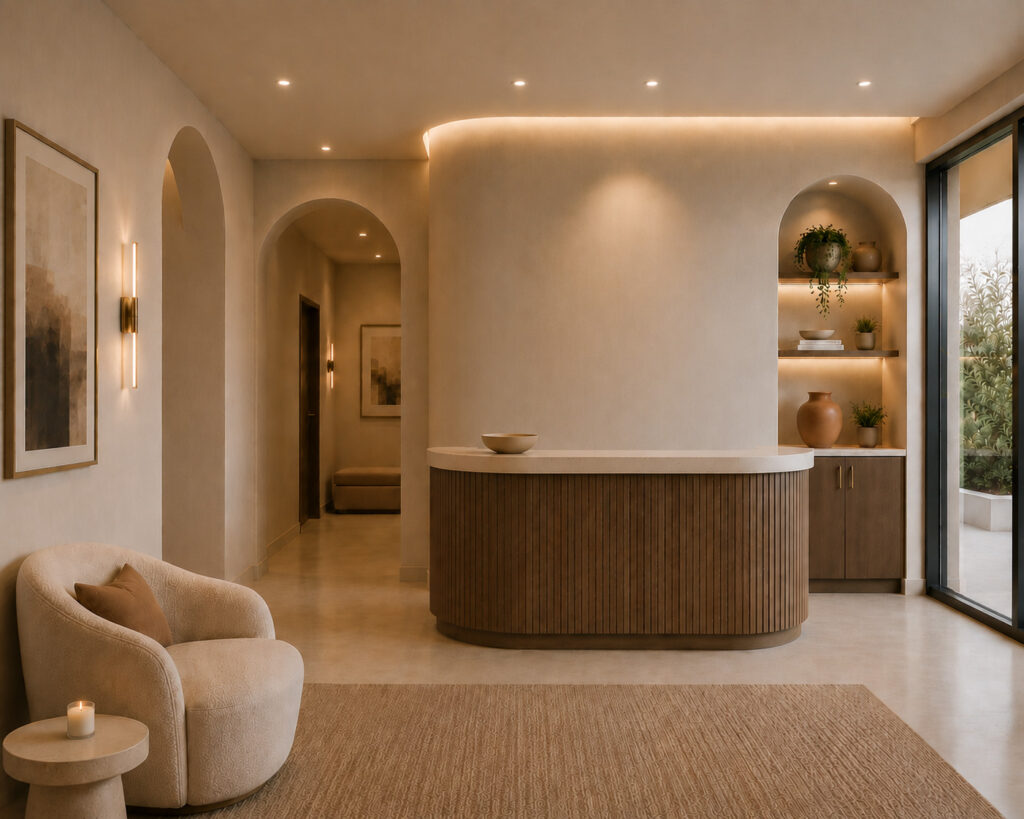
What Happens When an Emotion Lingers?
Researchers studying human chemical communication have explored whether emotional states can influence people who enter an environment afterward.
In one experiment, a group of participants watched a scary movie. Another group later entered the same room and experienced increased anxiety before they had even begun watching the movie themselves. When the experiment was repeated using a comedy, the people who entered afterward reported more positive emotions before watching anything.
The findings raise an intriguing possibility that, under certain conditions, the emotional state of one group may leave subtle biological cues in a shared environment that influence the experience of those who follow.
This does not mean rooms simply “absorb” emotions or that every anxious patient will make the next person anxious. Research in this area is still developing. What it does suggest is that our experience of shared environments may be more interconnected than we once assumed.
Consider What This Could Mean in Healthcare
Patients rarely enter a healthcare practice in a completely neutral emotional state. Someone may be worried about a diagnosis, anticipating a procedure, processing difficult news, or simply carrying the uncertainty that often comes with seeking medical care. At the same time, providers and staff are navigating demanding schedules, complex conversations, and the emotional responsibility of caring for others.
These internal states can influence how people interact within the practice. An anxious patient may communicate differently with a staff member. A stressful interaction may affect the presence a provider brings into the next appointment.
Rather than viewing each appointment as an isolated interaction, we can begin to think of the practice as an interconnected environment where people, emotions, interactions, and physical surroundings continuously influence one another.
The Environment Can Become Part of the Equation
We can’t control the emotions someone carries in with them, the worry before a diagnosis, the dread before a procedure. But we can control how the space around them responds to that.
Think about what actually makes a doctor’s office feel stressful. It’s often the small things: hearing a hard conversation through a thin wall and wondering if others can hear yours. Not knowing where to go or what happens next. A room that feels rushed or impersonal. None of these are dramatic, but they add up.
Good design works against each of them. True privacy, walls and doors that actually block sound means a hard conversation in one room stays in that room. Clear layout and signage mean a patient isn’t guessing where to go, which removes one more thing their mind has to manage while it’s already managing worry. A quiet moment built into the path out, a seat, a corner, a few steps of pause, gives someone a chance to collect themselves before they’re back in a waiting room or driving home. And small choices that put a patient in control, like being able to adjust the light or turn their chair, give back a sense of agency that stress tends to take away.
None of this guarantees how someone will feel. But it removes unnecessary friction, and that matters.
It also doesn’t stop with the patient. Someone who leaves an appointment feeling steadier carries that into how they treat the next person they talk to, a staff member, a family member waiting for them. And a care team who has even a few quiet minutes between patients, in a space built to give them that, can walk into the next room more present than one who never gets the chance.
Multiply that by thousands of small moments a day, and you start to see how the space itself becomes part of the care.
Designing for the Experience You Want to Multiply
This gives healthcare design an even deeper purpose.
Instead of considering only how an environment looks and functions, we can also ask what kind of feelings and experience we want it to support. Once that intention is clear, decisions around layout, privacy, acoustics, lighting, materials, treatment spaces, and staff areas can begin working toward the same experience.
There is still much to learn about the subtle ways we respond to the emotional and biological signals of those around us. But the emerging science reinforces something we have long believed at Simour: the experience of an environment extends far beyond what we can see.
When a space helps one person feel safer, more supported, or more at ease, the influence of that experience can impact far more than we realize.